
Research
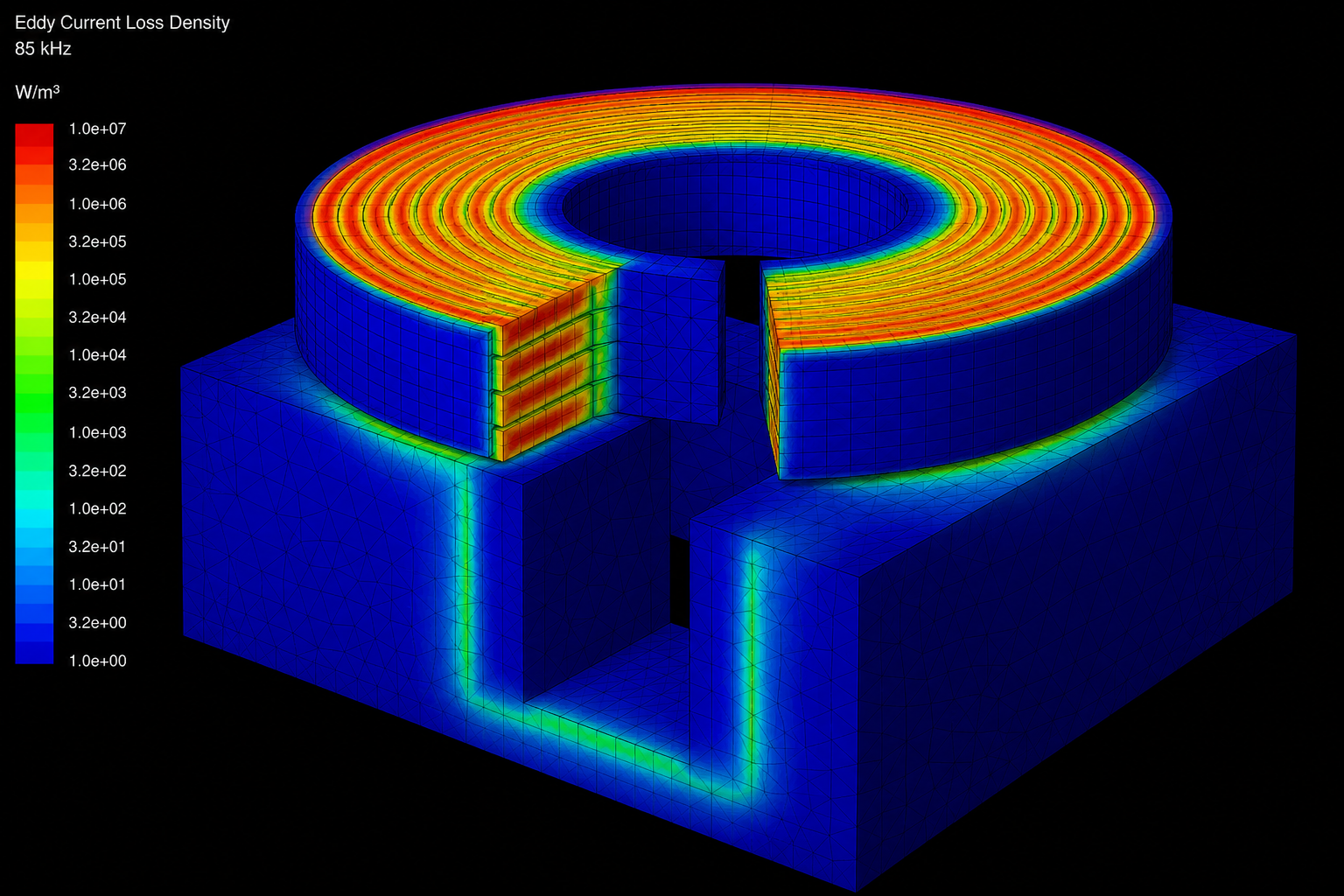
BRIDGE programme and the Maxwell 3D model of the 5 kW, 1 m link.
University of Coimbra
| Solver | Physics | f | Unknown | Mesh | Acceptance |
|---|---|---|---|---|---|
| Ansys Maxwell 3D | Eddy Current | 85 kHz | A | tetra + prism | M, k, R_ac, P_eddy |
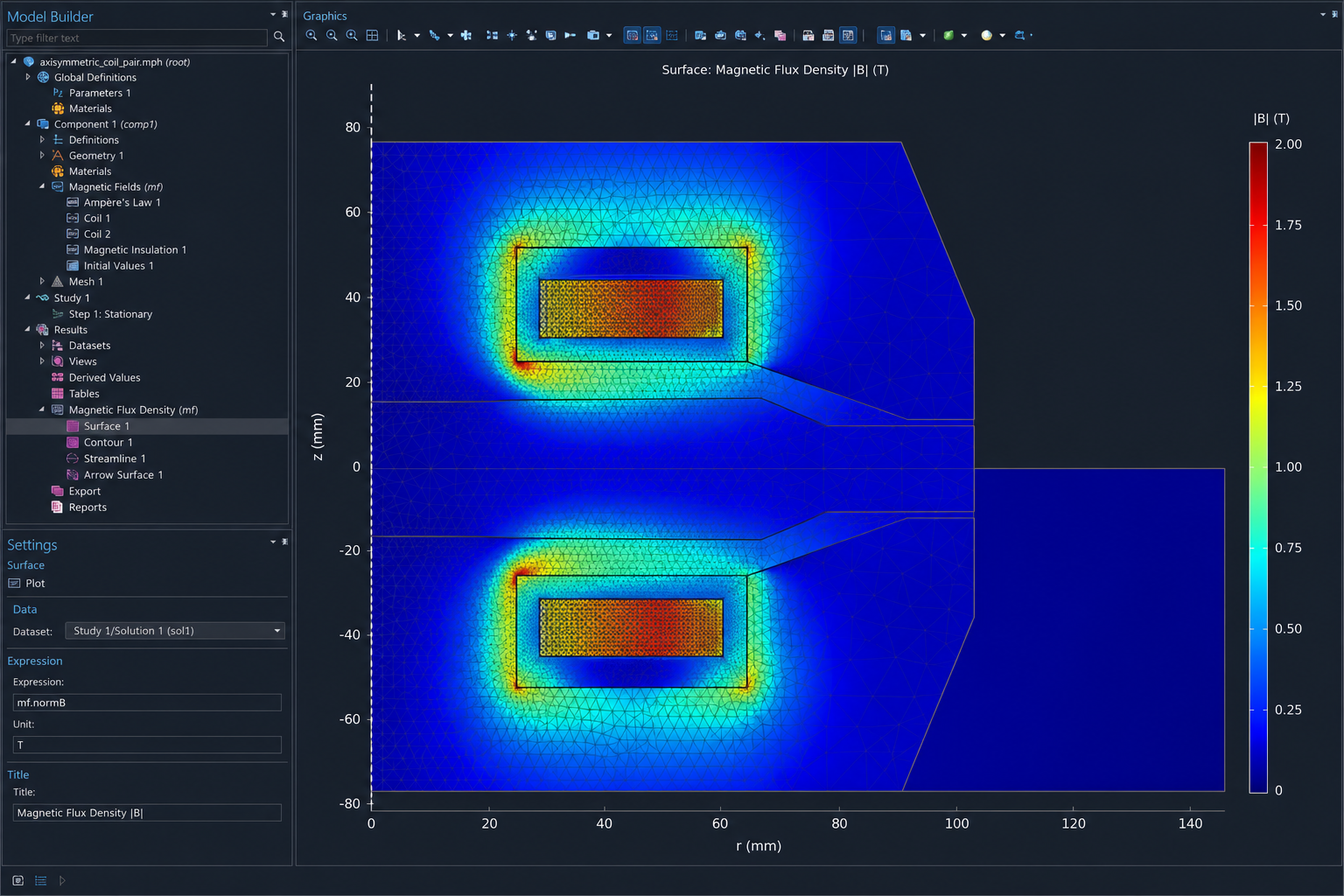
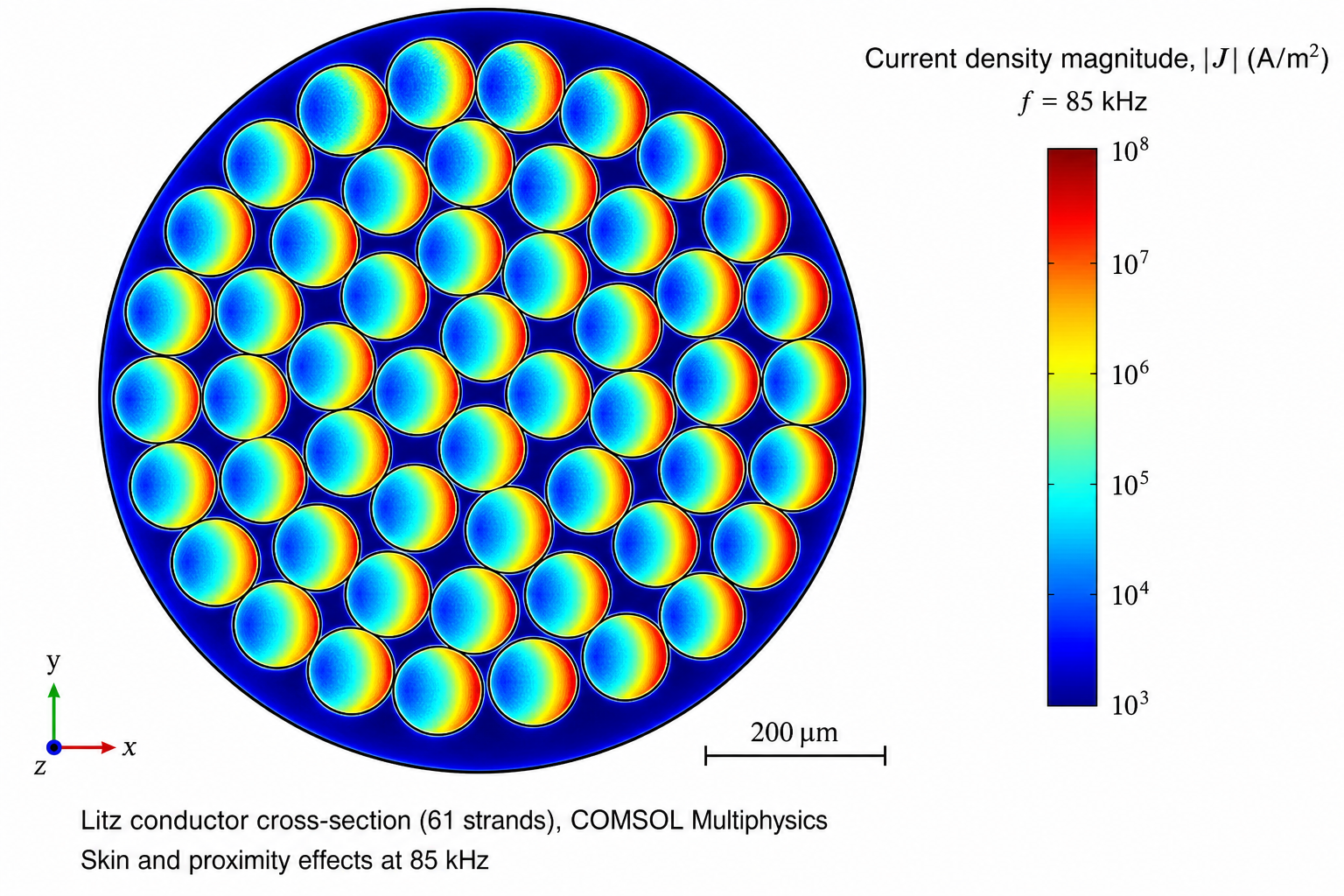
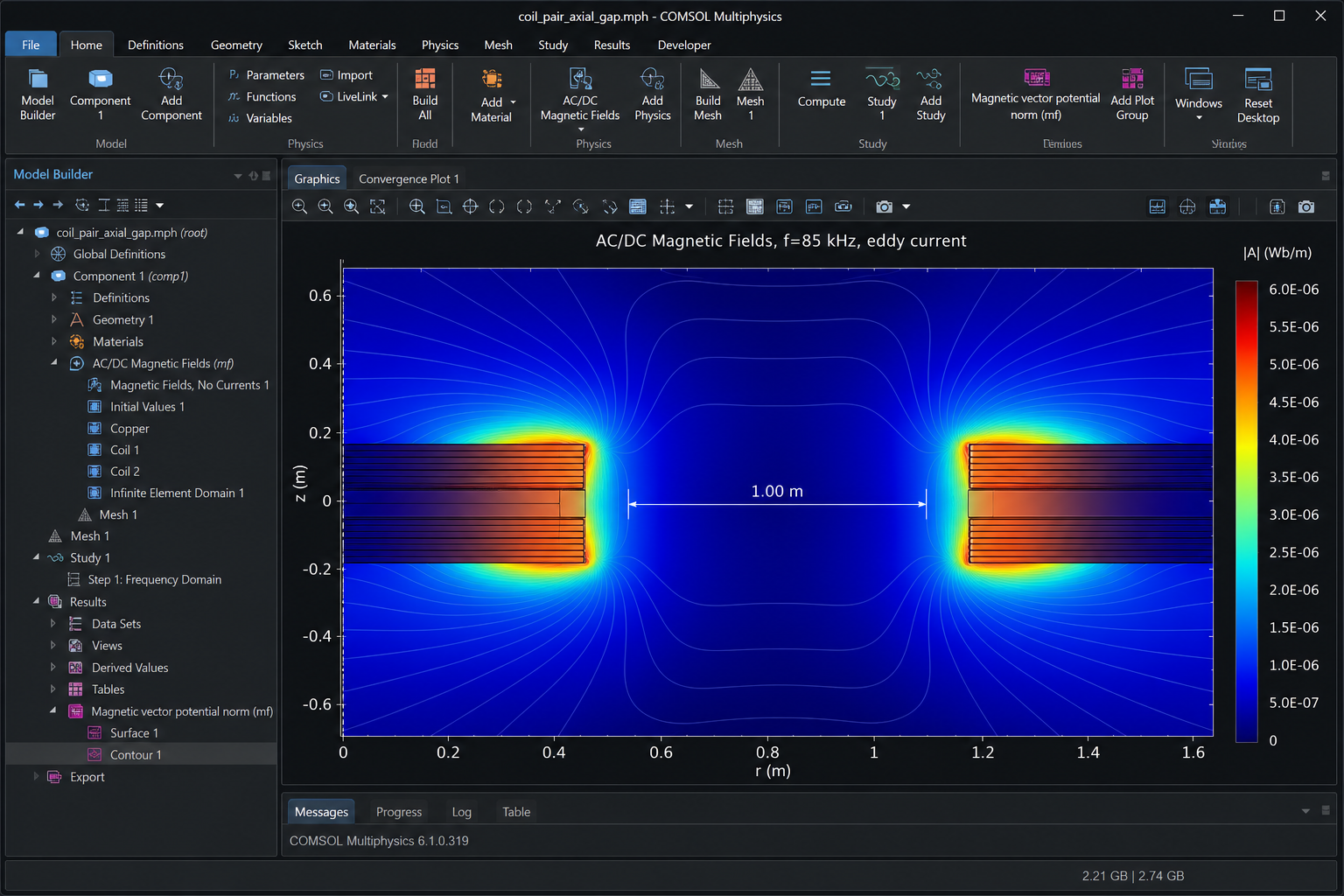
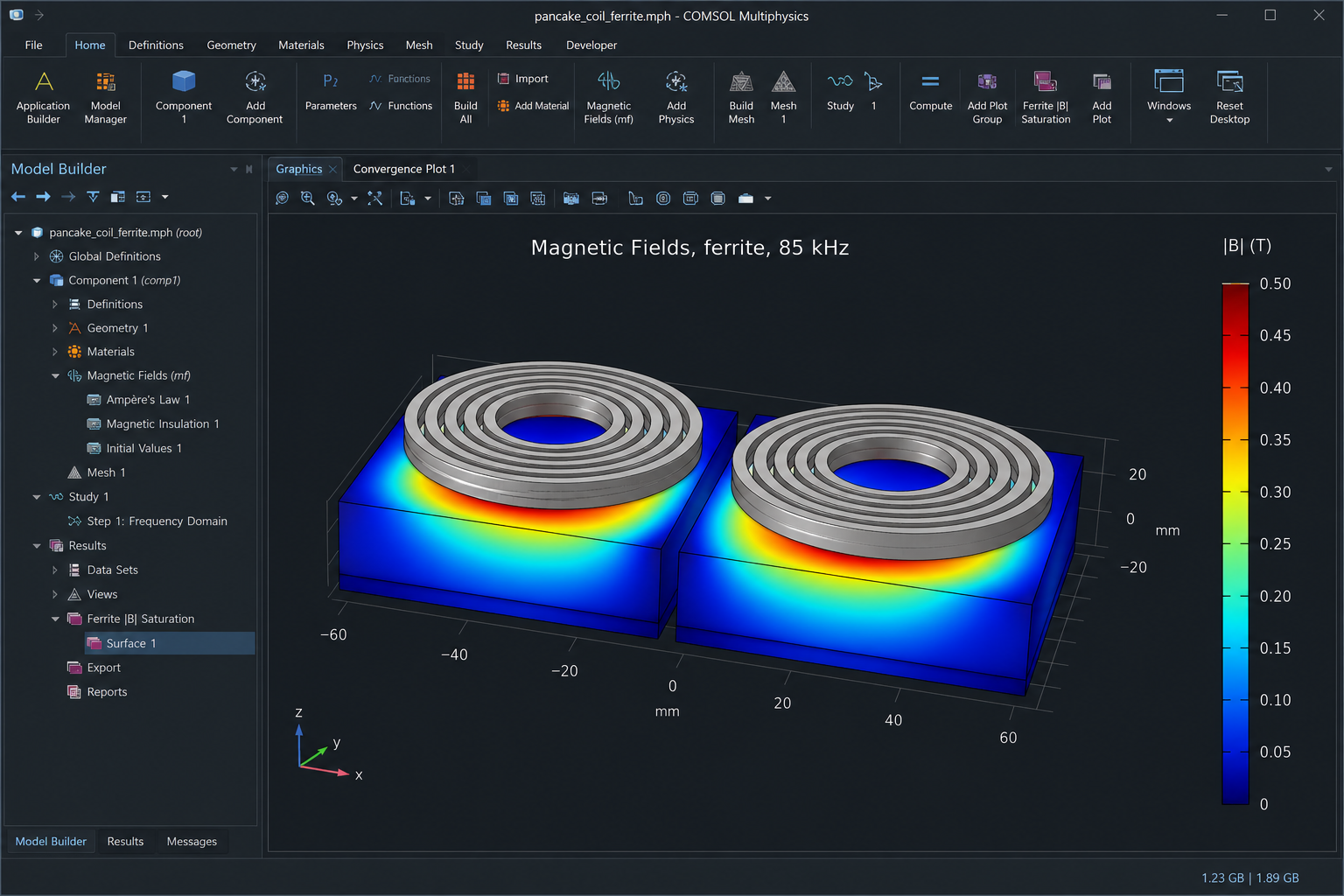
| COMSOL AC/DC | Magnetic Fields | 85 kHz | A_φ (2D-axi) | mapped + refine | J_Litz, |B|, ferrite |
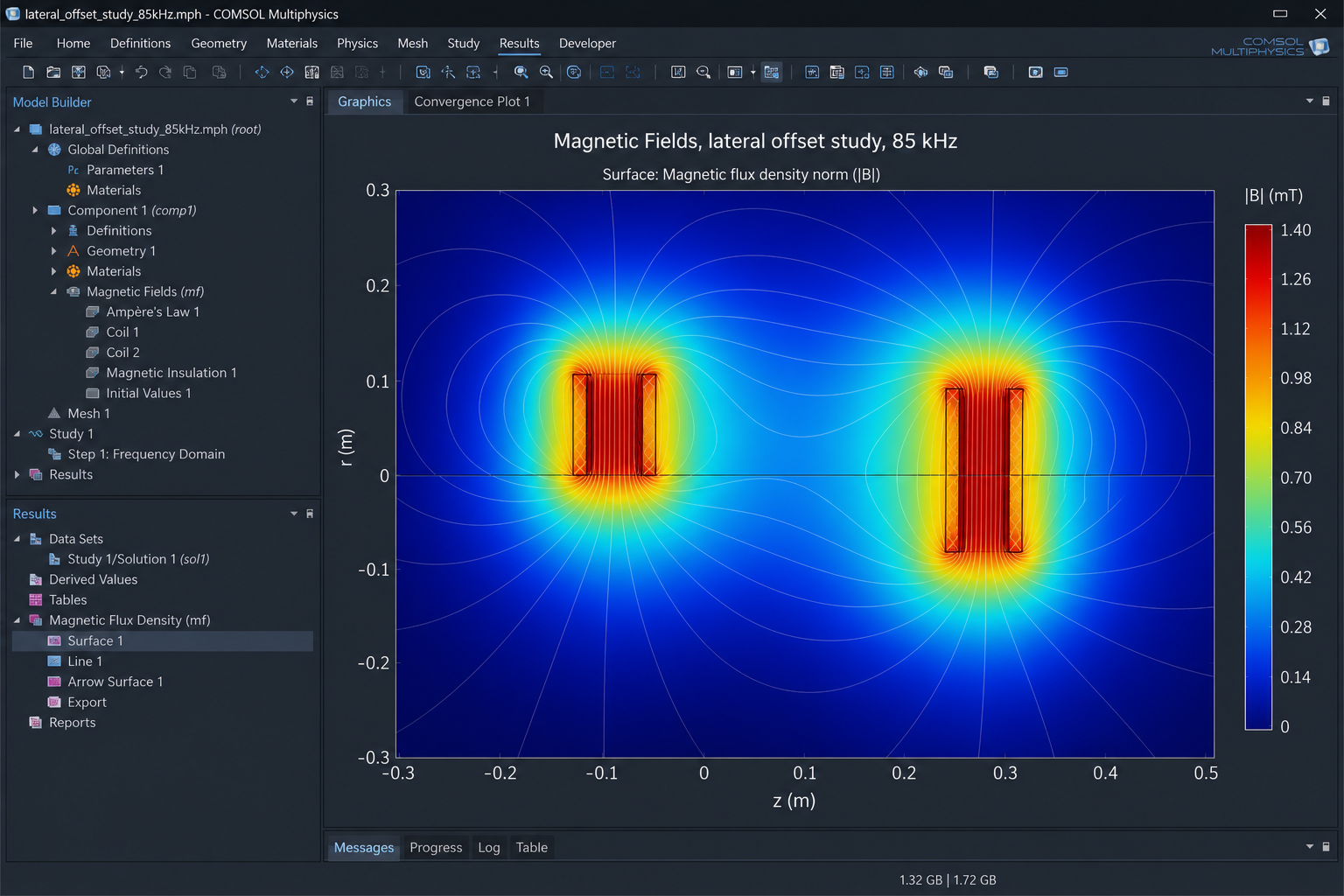
| COMSOL 3D | Magnetic Fields | 85 kHz | A | adaptive tetra | k(Δx), F_Lorentz |
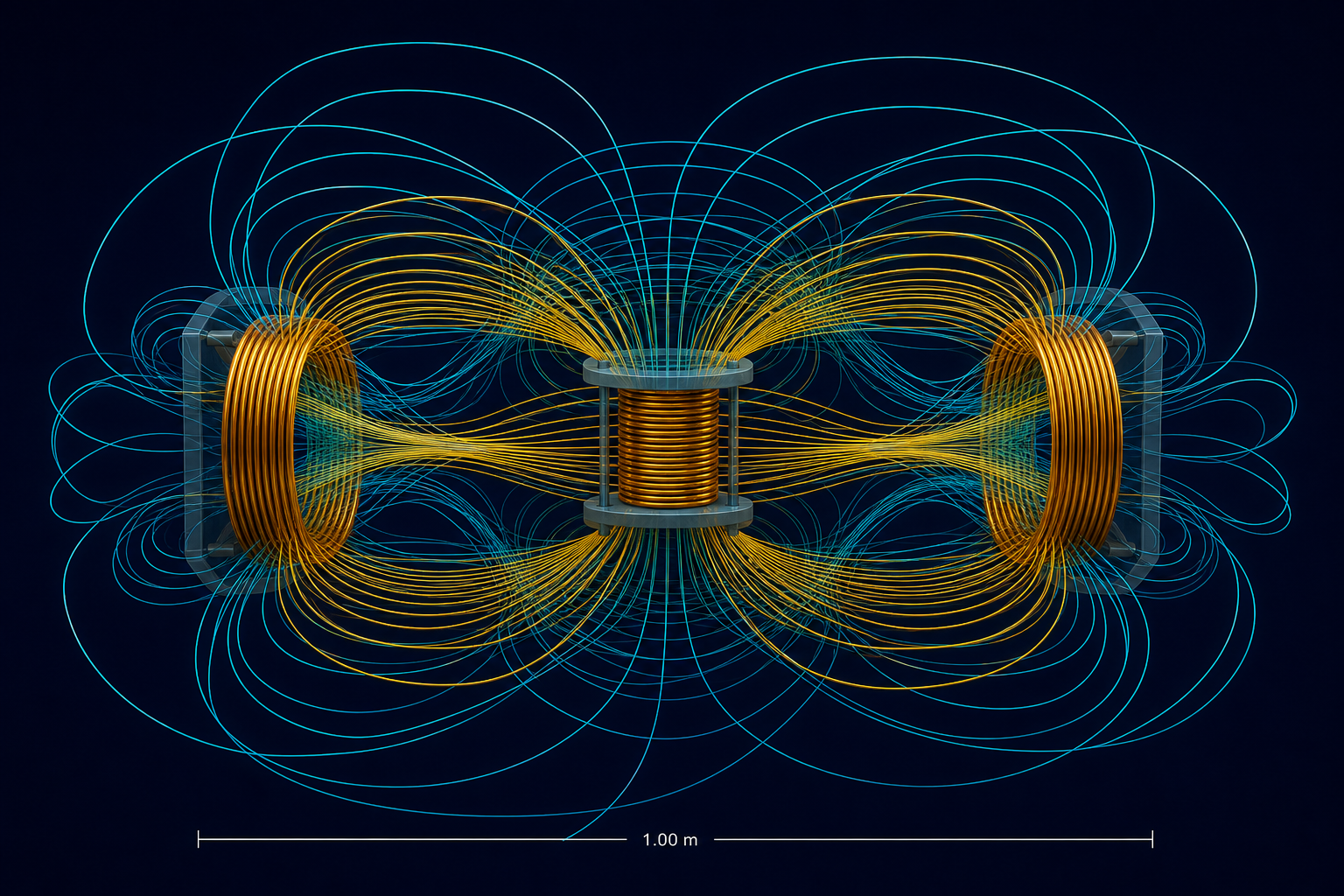
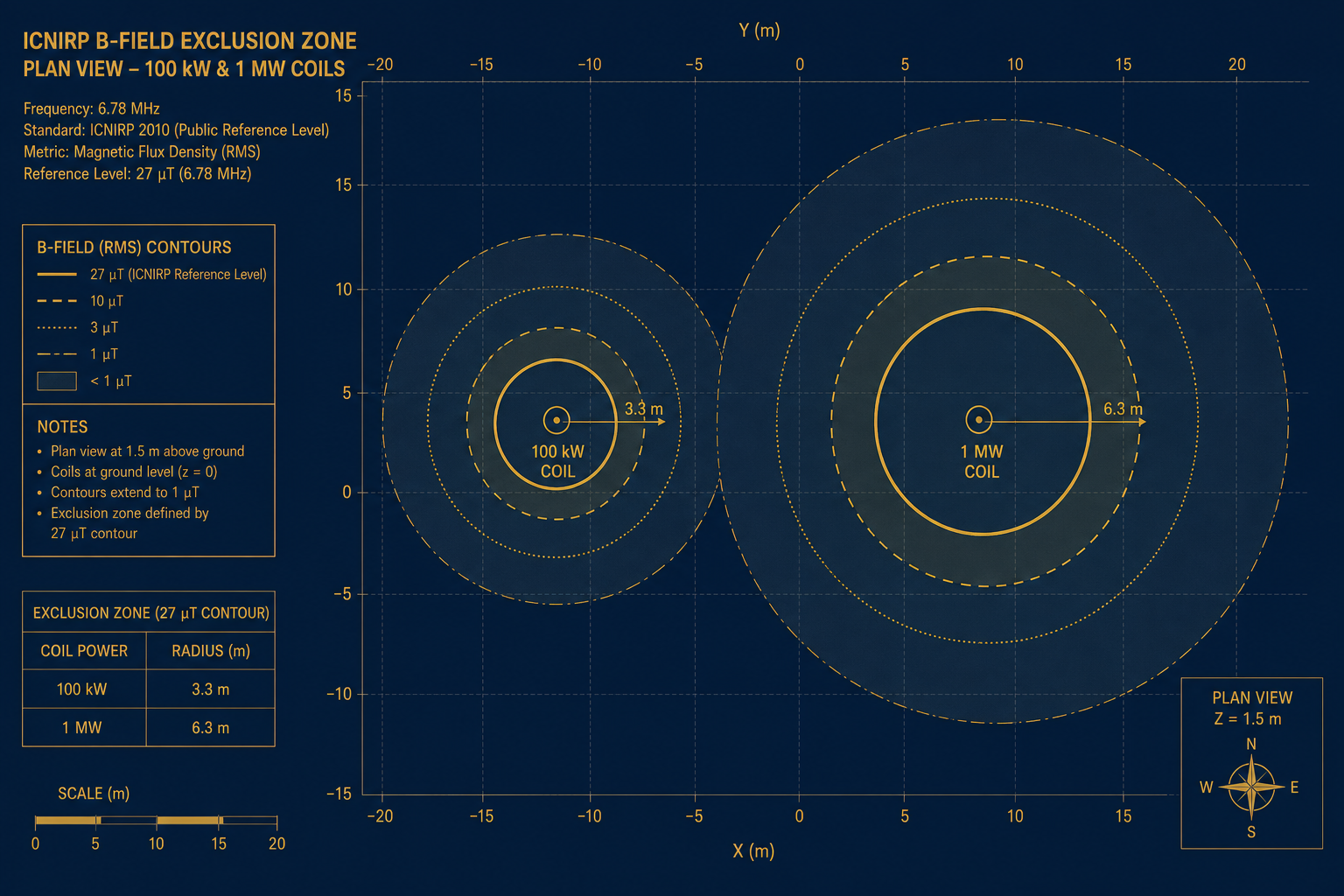
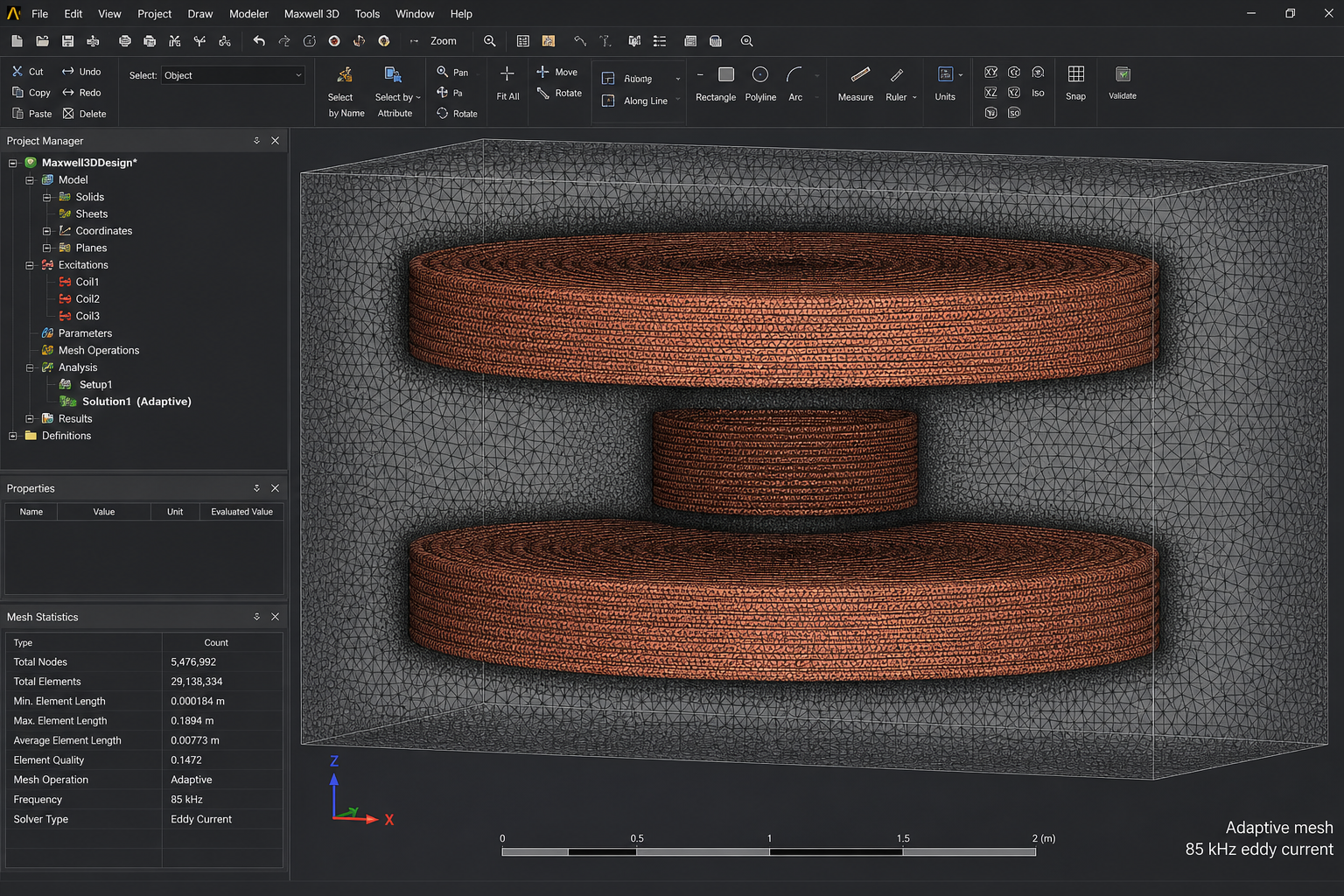
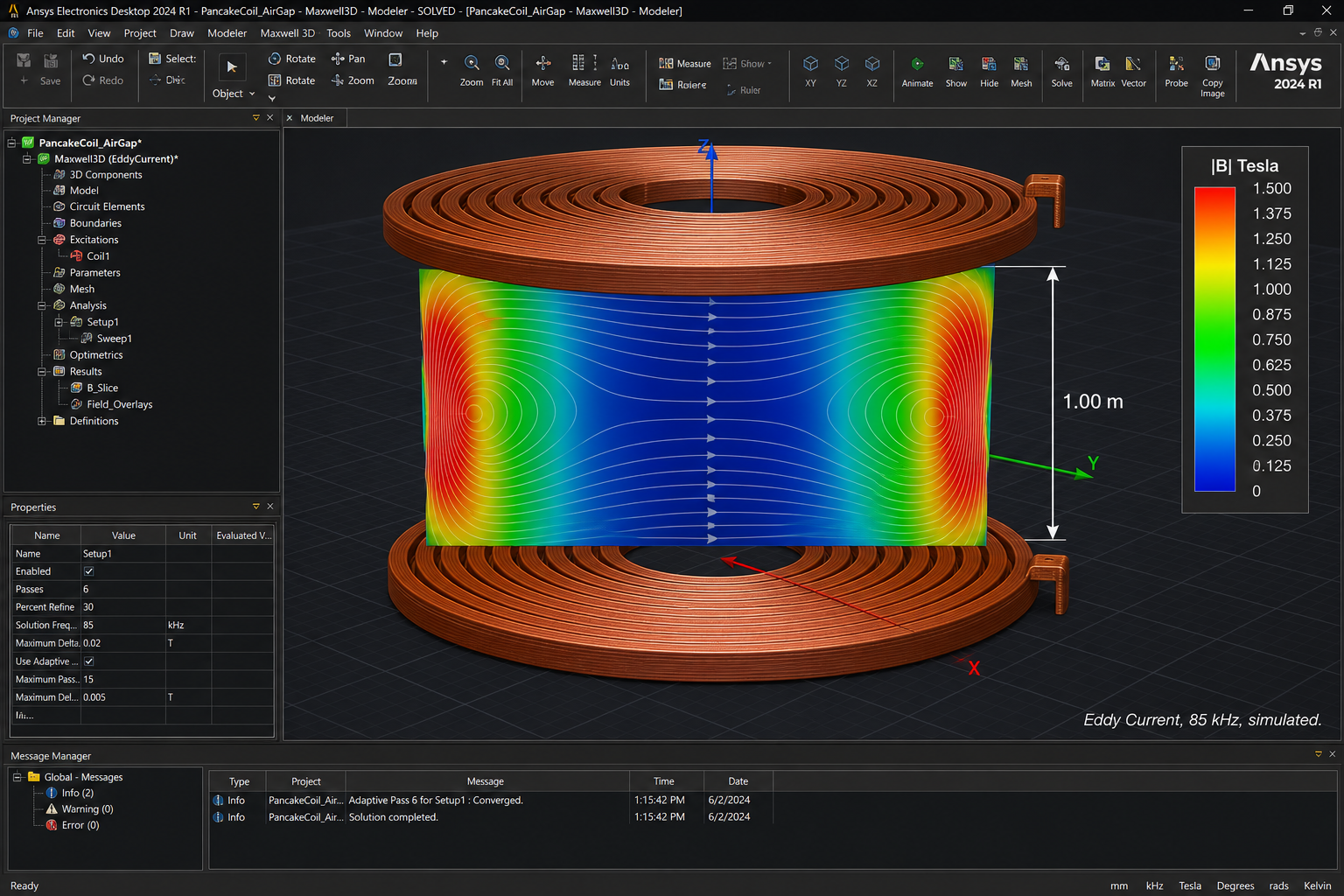
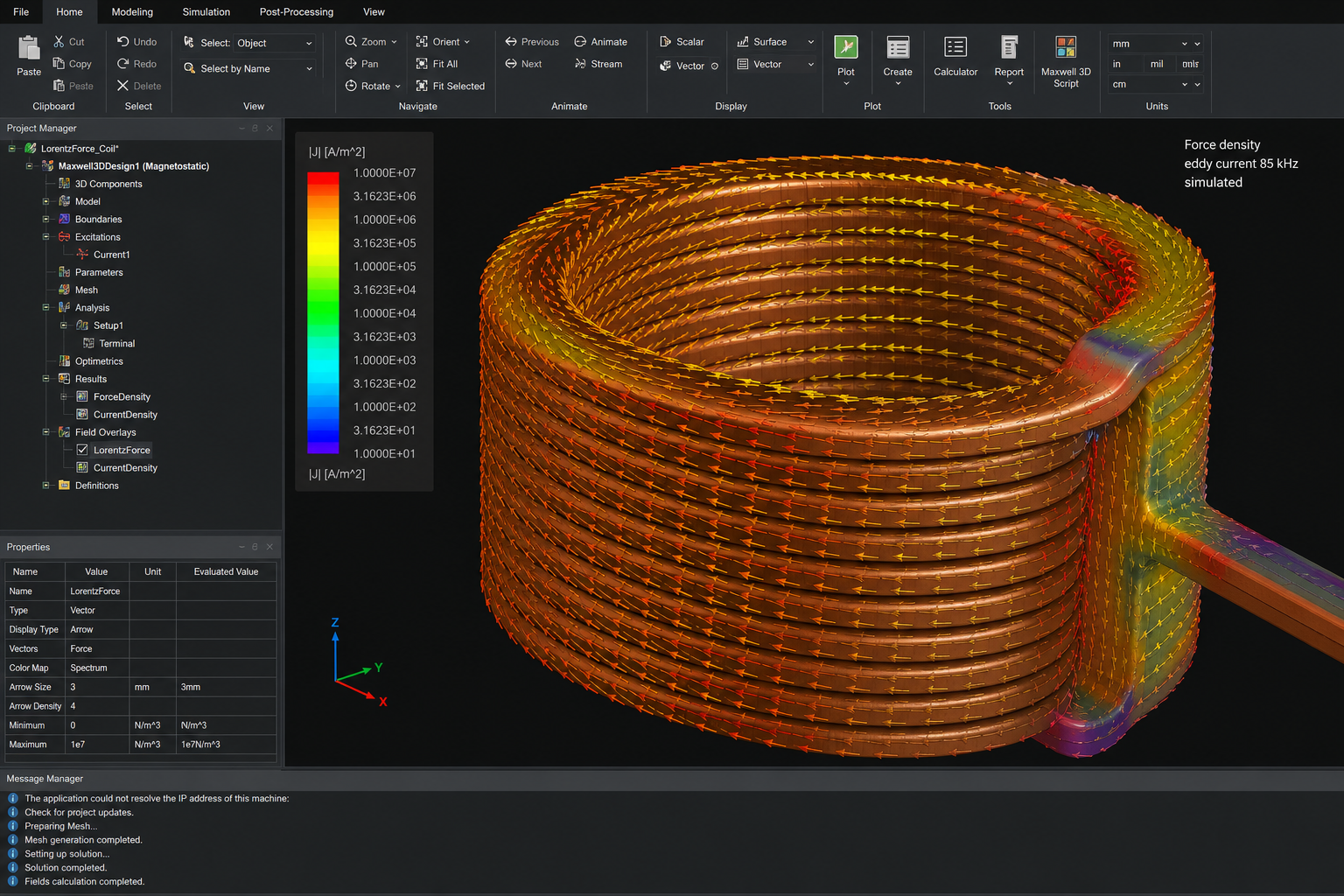
BRIDGE programme
Research at the University of Coimbra, DEI: Maxwell 3D model, coupled-mode analysis and the manufacturing package of the 5 kW / 1 m / 85 kHz link.
The corpus is the Maxwell 3D model, a COMSOL AC/DC cross-check, coupled-mode analysis, manufacturing package and hardware specification of the 5 kW / 1 m / 85 kHz link. Collaboration: research@nwpt.pt.
Formulation and cross-check
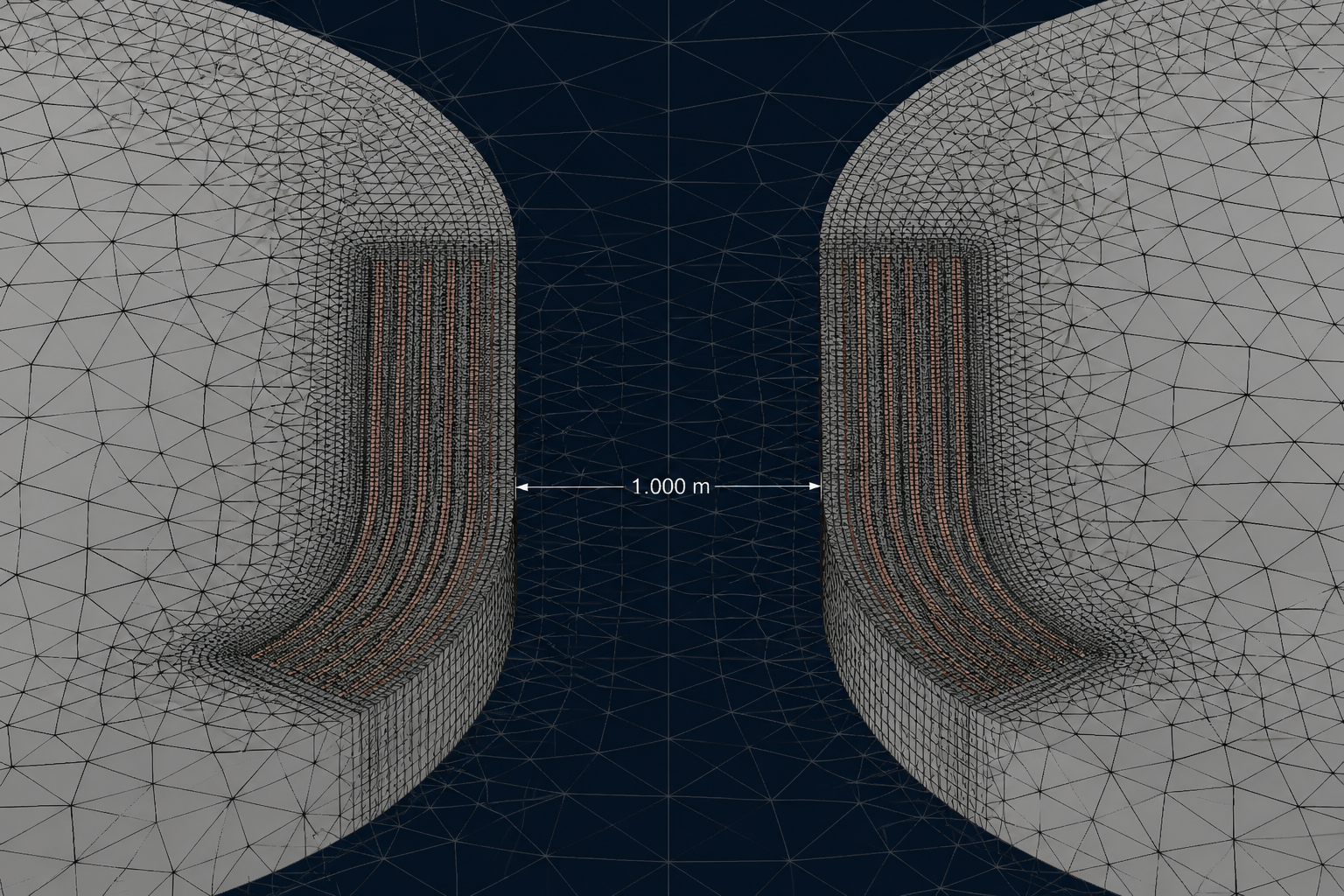
Maxwell: A-formulation (eddy-current) in the frequency domain. COMSOL: Magnetic Fields in 2D-axisymmetry for A_φ and the Litz mesh, and 3D when misalignment breaks symmetry.
Mutual inductance is the Neumann integral; FEM replaces it by energy extraction W = ½ Iᵀ L I. Acceptance quantities are k and R_ac — not how the field looks.
Research in high-power inductive transfer: Maxwell 3D, coupled-mode analysis and the manufacturing package of the 5 kW, 1 m link.
The work behind the 5 kW, 1 m, 85 kHz three-coil relay link: Ansys Maxwell 3D model, COMSOL AC/DC cross-check (A_φ, mesh, Litz J), coupled-mode analysis, manufacturing package and hardware specification.
The formulation is eddy-current in A; mutual inductance is Neumann / energy extraction. Model acceptance is convergence of M and R_ac, not how the field looks. No number on this page is a measurement above 1 kW.
5 kW across one metre: design complete and verified in Ansys Maxwell 3D, 97.18 % simulated coil-to-coil efficiency. Testing under way.
Collaboration and publications: research@nwpt.pt.
Model card — 5 kW link
| Geometry | Ø 1.10 m, axial stack, three-coil relay |
|---|---|
| Air gap | 1.00 m (design) |
| Frequency | 85 kHz |
| Solver | Ansys Maxwell 3D eddy-current; COMSOL AC/DC |
| Boundary | A × n = 0 at ≥ 5 coil radii |
| Mesh | tetra / prism; refine to δ/3 at 85 kHz |
| Convergence | ΔM and ΔR_ac < 0.5 % between adaptations |
| k (simulated) | 0.117 relay / 0.037 direct |
| η coil-to-coil | 97.18 % (simulated) |
| Measured (G0) | not posted |
Cite this work
There is no journal DOI. Cite the site technical report until a preprint exists.
@techreport{nwpt2026link5kw,
  title       = {5 kW inductive link at 1.00 m: Maxwell 3D specification},
  author      = {{NOVEA Wireless Power Transmission, Lda}},
  year        = {2026},
  institution = {NWPT},
  address     = {Coimbra, Portugal},
  url         = {https://www.nwpt.pt/en/research/},
  note        = {Coil-to-coil efficiency 97.18 percent is simulated. Not energised above 1 kW.}
}